Life’s Stories

Most of what makes a book good is that

we are reading it at the right time for us.

…Alain de Botton

On a recent trip to Canada it was brought to my attention that I often make book recommendations to friends. As I shared a book I was reading and enjoying during a coffee outing, a friend said he kept a running list of my recommendations on his phone, while another told me how much she enjoyed a book I had recommended to her. The new participant in the conversation took out a pen and a notepad to write down the title of the book I was reading and liked, and I felt a tiny thrill at this. Later, when signing my own books at an event, I suggested another title to someone purchasing my book. The bookstore employee laughed and thanked me for supporting other authors. I shrugged. I like books. I like talking about books. It feels very natural to me, perhaps because books have always been a huge part of my life and have provided a blueprint for living that I very much needed. As I read about people going through desperate times I have found myself thinking if they can survive this… But that’s another blog I’m not quite ready to write.

Over the years my recommends list has changed, and sometimes I provide caveats, like with the Catcher in the Rye. I loved it when I was younger (see opening quote) but my all-consuming love for Holden Caulfied has waned over the years as life took away some of my own softness, I think. There are other books that I think have a distinct audience. I recommended The Girl’s Guide to Hunting and Fishing to a lot of female friends who claimed not to like to read, knowing it would sway them, and it did. I don’t think I ever recommended it to a male friend.

I have some books that live inside me that I don’t so much recommend as almost force people to read. Books that spoke to me, changed me, made me think, and books I return to for comfort. Some where the writing skill left me in awe, some that helped me become a better person. A few of which I consider friends. I’ve written about some of them here.

The Bell Jar by Sylvia Plath.

It was a queer, sultry summer, the summer they electrocuted the Rosenbergs, and I didn’t know what I was doing in New York.

How is that for an opening line? As far as I’m concerned, it doesn’t get any better. The reader meets Esther Greenwood, a young woman from a poor background suddenly working at a fashion magazine in New York. Her story of trying to find her way spoke volumes to me, and not long after I moved to England I drove to Hebden Bridge in Yorkshire where she is buried to pay my respects to a woman who left this world far too young, and who had similar taste in men as myself. I own several copies of the Bell Jar and have bought it endlessly as gifts. The writing is sublime from beginning to end, with the last line of the book as powerful as the first: I took a deep breath and listened to the old brag of my heart: I am, I am, I am.

The Vanishing Act of Esme Lennox by Maggie O’Farrell

I don’t know how this book came into my possession. I think an old boss of mine said she liked the author, Maggie O’Farrell. My copy is slightly banged up and looks like it may have been exposed to the rain. Usually this bothers me, but I think the wear and tear adds to the impact of the off-white jacket with red lettering.

The premise for the story is simple – while at work one day Iris Lockhart gets a call that changes everything she knows about her family. She learns she has a great aunt who has been locked away in an asylum for years and Iris needs to find her a new place to live. She brings her to live with her in Edinburgh and soon family secrets come to the surface. It is a look at how society treated women who dared not to conform, and how perceived shame and the lies told to cover it up twists lives for generations. A thousand thumbs up.

Six Graves To Munich by Mario Puzo

Once upon a time as a publishing sales rep, I had the supreme good fortune of selling books chosen by the legend that is Christopher MacLehose. Six Grave In Munich was written by Mario Puzo (of The Godfather fame) under the name Mario Cleri. It tells the story of an intelligence officer named Michael Rogan captured by the Gestapo who survives being tortured and returns to Germany ten years later to seek revenge. I don’t want to ruin the story for anyone but let me tell you in this story, recollections indeed vary. Cleri has a handful of characters involved in the same event who have entirely different memories and interpretations of what happens – a strong reminder that you never know what someone else is thinking.

I remember setting the book down and wondering what kind of wizard Puzo was, that he could have one straightforward act of evil be so nuanced and misunderstood in its retelling. I’m still in awe of his understanding of human nature and his writing skill.

I know This Much Is True Wally Lamb

This is an enormous doorstop of a book, and I’ve read it twice. Another perfect opening line: On the afternoon of October 12, 1990, my twin brother Thomas entered the Three Rivers, Connecticut Public Library, retreated to one of the rear study carrels, and prayed to God the sacrifice he was about to commit would be deemed acceptable.

As we say in the Martimes, Gentle God. This book ripped my heart out and even as I clutched the tissues, I could not stop reading it.

I Know This Much Is True tells the story of twins Thomas and Dominick Birdsey, one who has schizophrenia and one who does not. They are being raised by their mother and stepfather, a man with questionable parenting skills. As a reader you feel for both brothers for different reasons, and you wonder just how much a person can deal with and survive. It is a story about family loyalty and (for me perhaps) a look at how seemingly small events leave deep, lasting scars.

The world would be a better place if we all had a brother like Dominick Birdsey.

Anna Karenina

One of a handful of books I have read more than once. On the surface it is a story of a married woman who leaves her husband when she falls for a younger man. Not exactly groundbreaking now, but at the time this was a slap in the face to all societal norms. Each time I read it, I see something new. As a sixteen-year-old reading it in high school, I felt deeply for Anna and wondered why she couldn’t trust her love with and for Count Vronsky. In university I started to think about the destructiveness of passion and guilt in life. The last time I read it I thought about how destructive relationships can be, and how Anna’s life would have been easier had she stayed home the night she met Vronsky, but that comes from my own life experience now.

Recently I found myself wondering if Tolstoy’s editor asked him to change the ending, to make it more palatable and filmable perhaps. Again, life’s experiences coming into the mix.

Travels with My Aunt by Graham Greene

I like Graham Greene. I liked Our Man In Havana although I didn’t really understand it the first time I read it. I think Dr Fisher of Geneva, a story about a man who invites people to a dinner party who can either win a million dollars or be struck down by a b*mb was clever, a literary precursor to Survivor.

Travels With My Aunt is a story of a retired bank manager who meets a woman he believes is his aunt at a funeral and embarks on a European adventure with her. I read it sitting in the library of my high school and found in inspiring. Greene’s other books seem to have more acclaim, but this was his best for me. Perhaps because I didn’t have to ask anyone about Cuba and the Missile Crisis to understand the different paths we take, or how we can be done in by our own fears and settle for too quiet of a life. It shows us how the people we meet change our lives – for better or worse. It is yet another story dealing with family secrets but to me it was the main character’s move from tending his dahlias to embarking on smuggling as a career choice that spoke to me as I sat in my high school library, biding my time. 

Lean On Pete by Willy Vlautin

Willy Vlautin is a modern-day Steinbeck, telling stories of the poor and marginalised with a touch that keeps it genuine and eye opening without being too heavy. Victor Hugo could have learned a few things from Mr Vlautin (and yes, I know he died long before Vlautin was born). I read Les Miserables when I was too young and found myself worrying about Fantine when I should have been paying attention in math class.

Charley Thompson is a young man left orphaned after the death of his father. He befriends an old racehorse named Lean On Pete and decides to save him when he is going to be put out to pasture for good. Charley also wants to find an estranged aunt of his as he does not want to end up in care. It is a coming of age story that reminds you how hard some people have it, and how much we all struggle.

Rilla of Ingleside

A young read perhaps, but I have yet to outgrow it.

Rilla is the daughter of Anne Shirley, better known as Anne of Green Gables. Anne married Gilbert Blythe and had seven children (only six of which survive into adulthood)

before moving to Glen St Mary and living in a big house called Ingleside. Rilla was born Bertha Marilla (And why would you do that to a kid?) which was shortened to Rilla; she came of age as World War one raged.

The book opens at a lighthouse party where news of war in Europe breaks out, exciting the young men and boring the young women. We then spend four years with Rilla as she navigates growing up while watching three of her brothers and so many of her chums go off to fight. It staggers me to this day how much I learned about World War One reading this book, and when I saw Courcelette, where tanks were first used in battle, it was of an imaginary character named Walter Blythe, son of Anne, who I thought. As I stood at Langemark German Cemetery in Belgium I thought about being twelve years old and reading about the Days of Langemarck (spelled with a ‘c’ back then).

The book introduced me to battles of the war, the world leaders at the time, and how Canada changed as a result of the conflict. As I read about the horrors and the heartache and grief of so many, it taught my twelve-year-old self empathy too, although I wish that was a lesson I learned after high school. Maybe after university, too.

Apart from Bill Bryson’s travel books, I don’t tend to read humour, but if that is your thing, I recommend The Stupidest Angel by Christopher Moore or anything by Carl Hiaasen. Because as we hear in Rilla of Ingleside, ‘A good laugh is as good as a prayer sometimes’.

Others for another post:

Lucy By the Sea Elizabeth Strout

The Magician’s Assistant Ann Patchett

The Art of Mending by Elizabeth Berg

Thin Places Kerri ni Dochartaigh
Travel Snippets

It’s been a while since I’ve added to my travel snippets, and although I have not been traveling as much as I would like to (I’m not sure that is even possible) I have been a few places recently.

Italy

Verona (April 2026)

Where I stayed in a very nice hotel that looked out onto Juliet’s balcony. The mini fridge was filled with complementary booze and there was a drawer of snacks that was replenished daily. The market was mere steps away and I was reminded that fruit in Italy is the best.

Valpolicella

Where I learned that it is not only acceptable but recommended to keep some red wine in the refrigerator. This was huge for me, as I have always kept summer reds in the fridge. I wanted to call a few friends and let them know but decided to be a bigger person and write about it here instead.

On the tour I met a lovely Canadian couple and talked about hockey while sampling wine. Good day.

Lyon (May 2026)

Where I was reminded that I have a wonderful friend after a bad night. Let me explain.

Getting the train from the airport to the city was a challenge, and my friend and I walked a lot of steps and tried several ticket machines that did not work before finally finding the right one and getting onto the shuttle and into the city. From there we grabbed a tram before making it to our hotel. I was reminded of how great it is to travel with someone who can read a map and has a keen sense of direction. As he studied the map and I daydreamed, I remembered a time I asked a local for directions, who started off with ‘you want to head east’ to which I replied, ‘If I could tell which way was east, I probably wouldn’t be lost.’

We walked around Lyon until we found one of the few places still serving food at 3 pm, proudly announcing they served food all day. This is something I will never fall for again as several hours later I was trying my hardest to not wake my travel friend as I was sicker than I have ever been in my life. When I knew what was coming, I slipped from bed and moved in the dark to the bathroom, where I closed the door and put down a towel to keep the light out. I will spare everyone the details, but after a few hours his light snoring made me furious and I kicked opened the bathroom door, letting the light and the toilet flushing wake him. When he asked, ‘Are you ok?’ I informed him in a croaky voice that I was not and needed water. Immediately he sprang into action, filling a bottle from the machine in the lobby then heading to a pharmacy and getting me tablets, which did not settle well, which resulted in him going to the front desk, and not knowing the French word for mop, miming the action. He was told it was not his responsibility to clean but we still did our best.

I spent the day in bed with a cold cloth on my forehead while he texted from the hike we had planned to check on me. He brought me a coke from McDonald’s, and it was the first cola product I’d had in maybe two decades. It was delicious. I drank it sitting on the rooftop terrace of our hotel while my friend ate his tenth or twelfth croissant of the day.

I thought I was over it. I was wrong.

Macon

Lovely day spent walking the streets and feeling better if not well. Had dinner outside (he ate, I watched) serenaded by a German shepherd dog sat at a nearby table that did not stop barking. I watched as the dog loving French diners threw dirty looks at the owners, who gave their pup chew toys and treats perhaps as distractions, but which functioned more as rewards for barking from where I was sitting. A woman sat down with a wee Dachshund that looked at the barking dog with absolute disdain from the safety of under his owner’s chair. It was both brave and adorable.

Entre Deux Lacs

My friend likes to book gites and local accommodations. He found one that looked charming, and in a very remote area. As we pulled up I despaired at the many things dotted on the lawn, but that was just a taste of what was to come. The house was cluttered with stuffed animals from fairs perching on shelves and chairs, including a large gorilla sitting on a piano bench that really creeped me out. As he went on a bike ride while I enjoyed another day of having an upset stomach, I asked him to please be back by dark. ‘I’m not staying here by myself!’ I added.

Rumilly

Where we stopped for a bite and a wander only to find most things closed – like a shop with a pair of shoes I still think about.

Annecy

Where I remembered why I love French pharmacies. My friend said if I was not feeling better he thought we should visit a doctor. I took myself to another French pharmacist and said I had been sick, I thought it was fish I had eaten, explained my illness and she gave me what I consider to be miracle powders. Little sachets of lemon flavoured magic that I tipped into my mouth right there on the street in Annecy. Within an hour I was feeling more human than I had in days, so I visited another pharmacy to buy skincare.

Later we went out for pizza and I had an entire slice by myself! There was a young couple sitting next to us and my friend was curious about what language they were speaking. Eventually he asked and we learned he was speaking Lithuanian. We then had a great chat about the history of his country and we both learned a lot. 

Note:

I am sad that I did not feel up to tasting the local beer, called biere verte, as my stomach being dodgy I nursed ginger beer the entire trip. If I ever find myself in Annecy again I will return to the pizza place and wash it down with the local drink.

Grenoble

We stayed in a lovely hotel and had a wonderful time exploring what is very much a university city. We took the cable cars known as ‘les bulles’ for their round shape from the city centre to the Fort de la Bastille, where we saw many people hiking, running and being very healthy on a cold rainy morning.

And then, we tried to leave the carpark. I still have flashbacks as my normally relaxed, gentle friend took the two cards the hotel gave us and tried and failed – repeatedly – to get the barrier to rise so we could be on our way. Eventually we reversed out of the exit, me craning my neck certain we’d hit something, as my friend inched back the way we came. We then drove against the arrows to the other exit where we were again thwarted. We asked locals for help and were surprised by the number hanging out in a multi storey car park who didn’t have cars and had never used the structure before. We tried to find a number to call. Eventually I observed we were wasting the day and I would tap my credit card and maybe that would work. My friend was not having it as we’d already paid and instead marched back to the hotel, where he learned three cards were needed. It was a remarkably complex and stupid system and when the barrier finally opened I doubted I would return to the cute hotel with the ridiculous desk staff again.

From Grenoble we returned to Lyon, where we dropped off our rental car only to be told we dented it although we both had no clue how (it’s an ongoing process right now). We then made our way to the end of one of the metro lines and were met by a friend who took us to her gorgeous home in a remote French village where she made fabulous meals and we took lovely walks before returning to the airport and bidding adieu to France, but not before a visit to duty free where I explained why Longchamp bags are so expensive to my lovely travel friend.

As we sat waiting for our flight, we pondered our next trip and threw out suggestions. I want to do an Irish road trip and he wants to see more of Scotland. We both agree we want to see Orleans. Next time I won’t eat the fish, and we will take the train.

Happiness

This is what I see:

A nice handbag. I have my eye on a few. Tom Ford’s Jennifer and Prada’s Aimee are at the top of the list.

Inside the bag is my old coach wallet, bought in Florida a long time ago. It’s a bit scarred and battered, stained from a slice of pizza bought in Sete, France. My friend put it in my bag, thinking the paper sleeve would protect it, and the grease spread. I was mad at him all day when it happened.

In my vision – or dream snippet of my future reality, I’m not sure – the weathered leather wallet is filled with cash: Twenties, fifties. Hundreds. I see Canadian, American, Sterling, euros and Aussie dollars spilling out of it, haphazardly, the way tissues fall out of my current non-Prada purse during allergy season.  

I throw the bag easily on the floor of the passenger’s side of my shiny SUV. Sometimes it’s a van, but one that is always easy to park. Whatever it is, I always see myself stepping up to the driver’s seat, as the new car smell wafts over me.

In this little snippet of my life’s dream, the sun is always shining and I’m always wearing comfortable shorts and a white tee shirt. My footwear alternates between flipflops and sandals – ones I can easily kick off as I love driving in my bare feet. Usually I’m parked under some trees, my van is clean and organised, the gas tank full, my bag full of money, and I am off on an adventure. The road beckons, and finally, I am on my way. I see this scene easily, and it comes to me often, unbidden, usually when I am tired or discouraged. Sometimes when I am trying to fall back to sleep. It pops up when I need some peace, some solace. To believe there are good things coming.

The best days of my life have been spent on road trips – finding places for coffee, seeing tourist sites, hiking parks, pulling over randomly to simply see the view. My first long, non-family road trip happened one summer when I drove with a partner at the time from New Brunswick to Vancouver, British Columbia, via the US. I camped in Acadia Park in Maine, spent a very hot and emotional day at Arlington Cemetery, had my picture taken outside the Fred Flintstone house in Bedford, Arizona; climbed the Grand Canyon, had fried chicken in Winslow, Arizona (Eagles fans will get this) biked and hugged trees in the Redwood Forest, and spent two days seeing everything in San Francisco. I remember changing my clothes in a jeep in a car park long before the days of CCTV. The 90s were the best time to travel.

Later I travelled through France on three different occasions with my friend Andrew, seeing Paris and Normandy and the chateaus of the Loire Valley.  I introduced him to the Doors in a small bar in Tours, cried my way across the battle sites of the Great War, and happened upon villages that were so small people stopped what they were doing to stare at us as we drove by. One time we were parked at a small road reading a map, trying to sort which way to go, when a local woman stuck her head in the car window and we ended up talking for almost an hour. She had on lovely earrings and her lipstick was perfect – and she lived in a town that had one old church, one street, and maybe two dozen homes. I joked with my friend as we drove away that she had dressed up for our visit. We sang along to Lobos I’d Love You to Want Me in a French restaurant after perhaps one too many glasses of Cotes du Rhone. We played Cribbage and drank cold beer and have had so many good times that we still talk about.

In 2018-2019, I visited Australia for the first time. I drove through the Blue Mountains and small towns in Australia, sleeping in shorts and a tee, too tired from the sun to change. I fell in love with Bellingen, Mullumbimby, Tweed Heads – places I only discovered because I was travelling with a local. I can’t wait to return, and I think that is why in my vision I see Aussie dollars. I am coming, Adelaide, one of these days.

The year is coming to an end and like most people I am reflecting on what transpired as I anticipate the reset that comes with an arbitrary date. Me, I can’t quite figure out 2025 – a lot of stuff that could be seen as being bad happened, but it didn’t really bother me much. Maybe some changes are like that. I did have a wonderful trip to Rome in April the weekend they buried the Pope. It was humbling and overwhelming to be a part of such history. I will always remember standing with a big crowd outside a large church, wondering what was happening and learning the Pope was being interred inside, and the crowd was standing vigil, while I was eating hazelnut gelato. It felt disrespectful, but that’s the Catholic still in me, I guess.

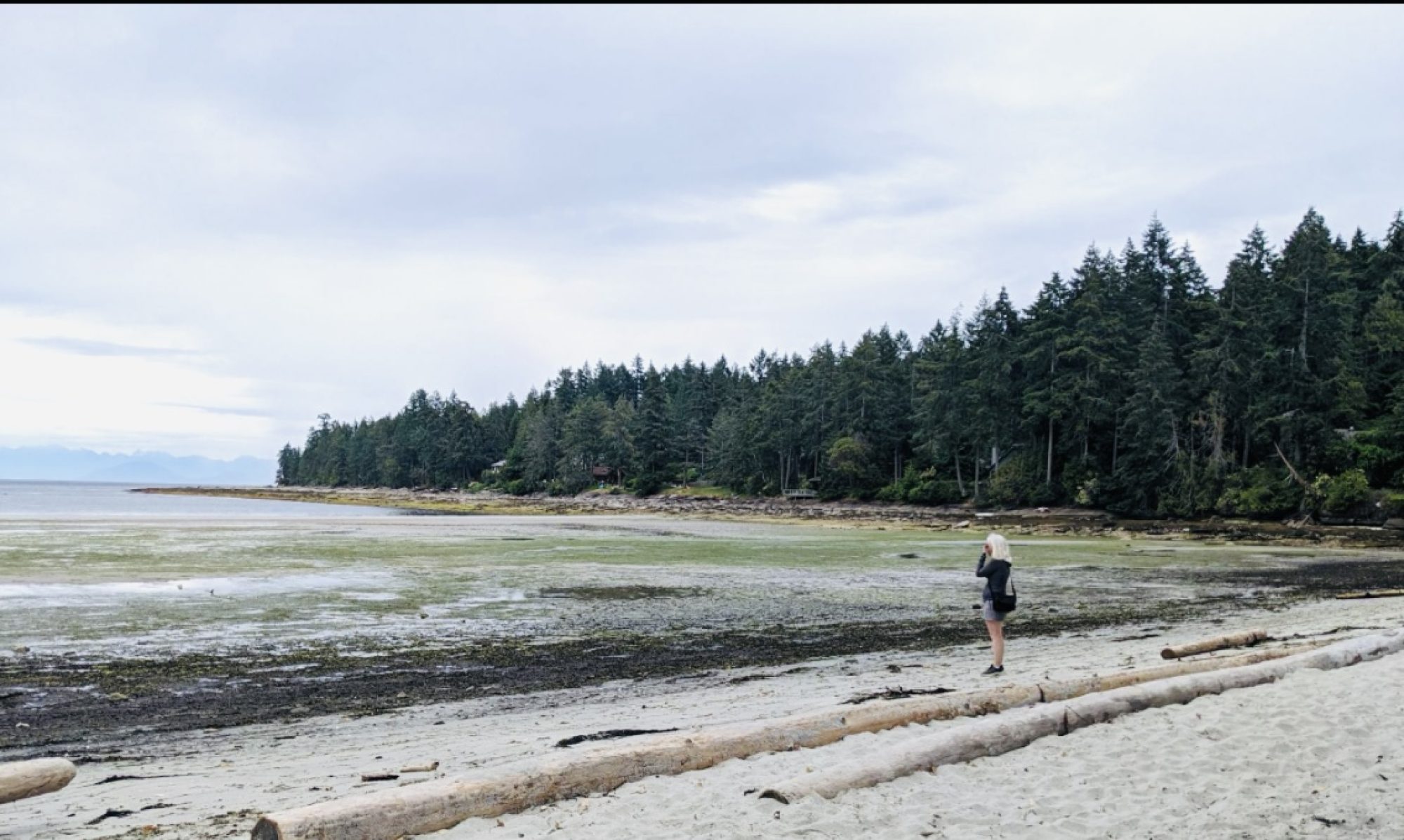
I spent the month of June in Canada, seeing friends in BC and taking a road trip through Vancouver Island. I signed copies of my books in Tofino and spoke at the library in Gabriola and had a wonderful event in Chapters in Nanaimo, where I made some new friends. I walked a beautiful beach (I can’t remember the name) and took a spill in Lighthouse Park. As I picked myself up my friend said, ‘I won’t tell anyone’ while I laughed. I’ve told a lot of people, and am telling many more now, here. I flew across the country and had an event in Indigo in Bedford, Nova Scotia. Later I played on a trampoline with the smaller members of my family after a glass of wine. All I can say about this is remember to point your toes, and that is harder than it looks.

In September I visited Naples and took the train to Pompeii. I’ve always wanted to see the place, but it was how the sun shone and the blue of the sky, how Vesuvius is smaller than I anticipated, and how good an ice-cold beer tasted that I remember more than the ruins – and wouldn’t it be nice if life worked that way, too? I thought about the woman we met travelling alone, who needed help with train times and knowing what exit to take, and how my friend helped her, and how we ran into her later that day and heard of her adventures. As we spoke, I thought perhaps she was lonely, travelling on her own, and after she walked away I mentioned to my friend that perhaps we should have invited her for a drink. He said he thought so too, but it was too late by then. I thought about her over the following few days, hoping she was okay, as we saw new places. We took a day trip to Sorrento, and I saw the hotel where Caruso had lived and for the thousandth time since he died wanted to call my dad and tell him all about it. He wasn’t much to travel, but he loved opera. I loved Sorrento, and finding new places to love has always counted as a win in the great ledger that is my life.

As this year has played out, and my publishing life has not shaped up how I had hoped – (see bad things that I think are good, noted above) I have thought about the ultimate road trip, also stated above, when the funds are unlimited and the whole world awaits. My way of visualising the perfect life for me: a nice handbag, money to travel, the open road. That is my idea of freedom, of happiness, a sign that I have made it. One day I believe it will be more than a snippet in my imagination, it will be my reality. That’s what keeps me going, some days. Until then I have trampolines to master, hills to climb without falling, and so much to learn.  

Here’s to 2026 and the kind of joy and life’s experiences, road trips and nice handbags bring – for me, at least.

In Napoli

Many years ago, when I was a very young child, my mother gave me vitamins from a brown glass bottle, kept on the door of the fridge. That sounds a touch ominous, like the start to a Flowers In the Attic style tale, but it wasn’t. I got my spoonful of orange vitamins and then my cod liver oil tablet before sitting down to whatever cereal was on offer.

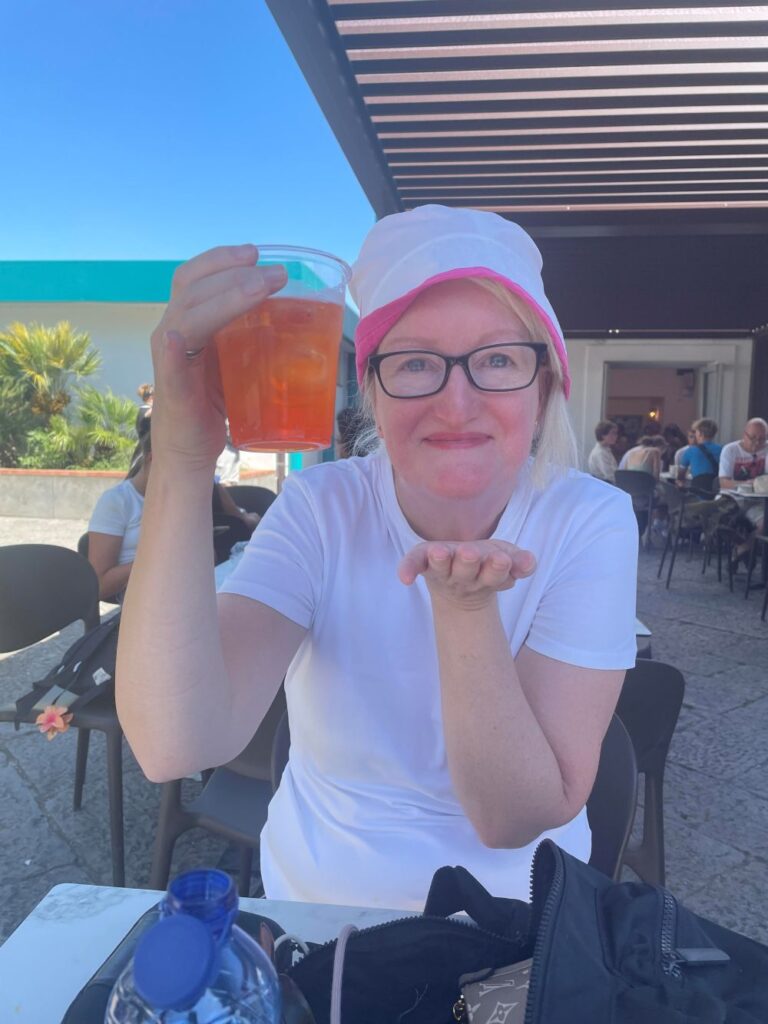
The liquid vitamins came in a bottle with a label featuring two children playing. The girl was wearing a yellow sweater and the boy a pumpkin-coloured shirt, if memory serves me correctly. They were jumping on a seesaw of sorts made from a spoon balanced over half an orange. I remember the taste of the potion well, although they were eventually replaced by Flintstones Chewables. I was reminded of these vitamins on a recent trip to Italy, when I had my first Aperol Spritz on a hot day spent walking around the ruins of Pompeii.

We’d arrived in Naples the day before, after getting up at three thirty in the morning to catch a 6:20 flight. We were flying business class, me tagging along on my friend’s pass. It was only my fifth time flying business class, and already I was jaded. The lounge’s breakfast buffet did not have eggs. The champagne on the flight was warm. Oh, the troubles I have seen.

My friend was snoozing by the window when a woman across the aisle stood up and opened the overhead bin. This always fascinates me, as I have flown a lot, on very long flights to places are far flung as Thailand, Australia, Nepal and New Zealand. Not once have I ever opened a bin to rummage around, yet this was the second time this woman had stood up, trying and failing to find something. As I watched, eyes gritty with tiredness yet wide awake with the excitement of soon seeing the Amalfi Coast, she hoisted her skirts around her hips, then stepped onto the armrest of the seat where a man was sat, ignoring her even as the hem of her skirt fell on his arm. I was captivated by the dynamic. If it was her husband, why was he ignoring her? If he was someone randomly seated next to her, wouldn’t he object to her standing on his armrest? As my thoughts swirled I poked my sleeping friend so he could see what I was seeing. I have flown a lot but he flies endlessly, for work and for pleasure. Let’s just say he came to quickly as the flight attendant rushed down the aisle, asking the woman to please get down, as what she was doing was very dangerous.

‘Whatever you need, madam, I will get for you,’ he said. ‘Please get down.’ She completely ignored him and carried on digging around in the bin until she pulled out a book and stepped down, her skirt catching on the arm rest as the man in the seat it was attached to continued to ignore her, and the flight attendant pulled himself together. I don’t know what would have happened to him if she fell, but he was taking it very seriously.

We landed in Naples then walked from the aircraft to a bus where we stood a while longer before boarding, while a man who had five gin and tonics (he was sat near me, and I counted) made jokes about needing tickets and tried to get a sing song going. Eventually the bus took us to what amounted to a holding pen where we stood endlessly in the baking heat while trying to figure out exactly what was happening. Slowly we made our way into a very grey arrivals area. I watched, clutching my UK passport and cursing Brexit, as everyone with an EU passport sailed by me.

We found the shuttle, made our way into the city and found our hotel, which let us check in early, which was fabulous. We dumped our bags, my friend found a map on his phone to navigate, and we set off.

Naples… I don’t really know what to say. Search the Internet and you will hear it described as raw, pulsing with life, and authentic. For me this translated to covered in graffiti with garbage littering the streets. Having been to Rome in April I was shocked by the difference in the two cities. As we walked along I kept my opinion to myself – heaven forbid anyone say anything negative these days – until my friend said, ‘I’m not digging the graffiti everywhere’ – to which I quickly agreed.

 After buying tickets to see the Sansevero chapel housing the Veiled Christ, a masterpiece in marble that defies description no matter how long you stare at it, we sat at an outdoor café – really just a few metal tables lining the street – and drank ice cold Peroni and shared a slice of Neapolitan pizza. Eventually we moved along, walking through a city enthralled with Diego Maradona and stopping for dinner at what looked like a cute outdoor restaurant. I had the worst grilled courgette and aubergine (zucchini and eggplant) ever while my friend had mediocre risotto and we watched a group of young lads on what may have been their first holiday abroad without supervision knock back pints, inhale pizza, and laugh. We walked some more, and I ended up buying a postcard sized painting from an elderly man sitting outside his shop, smoking a cigarette and staring into the distance. He wrapped it in newspaper, and I smiled as I wondered how I was going to get it into my suitcase – then we returned to our nicely air-conditioned hotel room and made plans.

The following day we rose early and hopped the train to Pompeii. Now, I cannot say enough good things about Italian trains. The ticket system is easy to use, and the fare is cheap. Dirt cheap. Two fares for two adults for a 38-minute trip cost just over six euros. The trains arrived on time and left on time and maybe I just got lucky, but passengers were quiet and respectful. No loud phone conversations or obnoxious music. Nicely done, Naples!

Pompeii was magical, in the way seeing a place on your bucket list is magical. The sun was shining but there was some early September morning cool which I love. I basked in it as I saw first-hand the city destroyed in 79 AD, a place I studied when I was at the University of Ottawa, several lifetimes ago. After four hours of walking over old bricks, we found the restaurant and had an Aperol Spritz, me for the first time. I took a sip and immediately thought it tasted familiar. Another sip and I knew what it was, saying to my friend, ‘it tastes like the orange vitamins I had as a kid’ which brings us back to the start of this tale, in case you were wondering where I was going.

Walking back to our hotel in Naples that night, we decided to visit Sorrento the next day. And I am so glad we did. From the moment we stepped from the train (less than 20 euros, return, for two adults for a 78-minute journey) I knew I was going to like the place. The air smelled fresh. The streets were pristine. Palm trees, cool looking restaurants and sleek shops were everywhere. Sorrento felt like a pleasant dream, the kind that makes you want to pull the covers tight, squeeze your eyes shut and just revel in.

After an iced coffee we made our way to a park with a view of the beaches below. As I gazed into the clear water dotted with people swimming and floating around, I got the feeling I was in one of those glamourous old films where a woman wearing a crisp white dress, cinched at her waist and wearing impossibly large sunglasses, a silk scarf holding her hair in place, hurries through the streets, scanning the crowd while being chased by someone like Cary Grant. Sorrento felt like something from another time, and I was loving it. And who wouldn’t want to be chased by Cary Grant?

We had lemon ices as we walked through the cave-like path that led to the water and the beaches. Watched some swimmers and some sunbathers before heading back to the city centre. I tried on a pair of shoes and talked myself out of buying them, wanting to be fiscally responsible. We wandered the clean, meandering streets as I looked for a hotel where I might one day stay, when Sorrento was more than a day trip. Then we returned to the waterfront for a glass of Champagne. While my friend ate calamari I watched the fish swimming in the clear water and pondered writing something set in Sorrento – a simple romance, I thought, watching a handsome man in blue swim trunks walking into the sea.

As the afternoon drifted by, my friend ordered a second bottle of Veuve Clicquot, and the waiter told us he’d lived in England and Australia and Spain, and that each Monday he sits on the beach with a bottle of Moet and Chandon and some smoked salmon and avocado and watches the sea. I tucked this away for the romance novel that was already building in my mind.

As we sat on the train returning to Naples, I tried to find the vitamins I had as a kid on Google but had no luck. I could see the bottle so clearly in my mind, knew the taste, as I had preferred them to the Flintstones that replaced them. We gave up after a while, and I opened up Notes on my phone and scribbled a few lines for the romance novel building in my head. I showed them to my friend who said, ‘I like it!’

By now the train station felt familiar and comforting. I stopped at a shop and looked at a bag in the window that I liked, but talked myself out of buying it, too. We ate ice cream and as we headed back to our hotel and I thought about some of the things that had happened on my trip to a new part of Italy: I fell in love with Sorrento. I gazed on the Veiled Christ. I learned Aperol Spritz’s taste like vitamins my mother gave me in childhood. I pondered writing a romance novel. But I knew the story I would tell the most would be about a woman who stood on an armrest in business class while the flight attendant pleaded with her to get down and her husband ignored her. That, like the Italian coast, is not something you see every day. Especially in business class.

Friends, Romans, Humanity.

Last January a friend mentioned to me that he had a companion ticket he had to use up by the end of June and might I be interested in a city break. Having flown first class with him to Copenhagen I was indeed ready for a trip and said I wanted to see Rome again. He agreed as visions of British Airways first class lounge danced in my head.

We were careful booking, wanting to be there before it got too hot, not during Easter or when school children were on break. Rome is a busy place. We booked for the 24-27 of April, feeling quite smart. ‘We should be okay, as long as the Pope doesn’t die,’ he observed. I was at the gym when he sent me a text saying, ‘The Pope just died. Our trip should be interesting.’ It grew more so when it was announced his funeral would be on the Saturday that we were there.

I first saw Rome when I was 21, recently graduated from university and completely and utterly lost in life. I remember Rome being huge, the traffic being scary, and wishing I was with my friend Tiff. It was on this trip I learned to be careful about who you pick as travel partners, but I’ve had mostly good luck since.

I had champagne on the flight mostly to brace myself for what I was sure would be the chaos of Rome, but the airport upon landing was almost empty. We walked straight through customs, even without an EU passport. At the bottom of an escalator we saw a group of priests huddled together and I thought, I wonder what the collective noun for a group of priests is? A religion? A pod? Given the news in the past years, my mind went to a few dark places.

As we took the train – clean, cool, comfortable, delightful, really – from the airport to Termini, I looked out the window at the passing landscape, thinking about all the area had seen as the image of Russell Crowe in Gladiator, walking through the fields, hand brushing the wheat, flashed through my mind.

Soon we were at Termini, and I was shocked at how big the station was. I remembered it as being a tube-shaped building, open at both ends with a few bakeries and coffee shops. The Termini I landed at had posh shops, bars, lounges – it was more like an airport – a really good airport – or a shopping centre from where trains happened to arrive and depart. The crowds that were absent at the airport were plentiful at Termini.

As we left the station I looked up at the buildings lining the street, wondering if I would see the place where I had stayed many years earlier, but we were greeted with a row of rather lacklustre shops, not the tall, multi-storey, off-white building on a corner I remembered. I hoped it was on the other side of the station and had not been torn down.

Our hotel was two minutes away. The lobby was nice, the staff pleasant, and the room, while not sporting much of a view – was lovely. The bathroom was tiled and the shower ‘threw off some heat’ my friend would later say.

Of course we headed immediately to St Peter’s, distracted along the way by motorcades and ridiculously handsome police officers. Carabinieri, polizia, and the Guarda de Finanza which confused us, but it wasn’t really their job descriptions that caught my attention. Somewhere on the application I am convinced it states: ‘Gorgeous men will be prioritized.’ But then, I’ve had a thing for Romans since studying their empire in grade ten history class. 

One of the main reasons I wanted to see the Eternal City again was to visit the Mausoleum of Augustus, Julius Caesar’s adopted nephew who ruled after him and was one of the Twelve Good Emperors of Rome. While not as famous as his adoptive uncle, under his reign Rome flourished. (And the first thing he did when he took power was to go after the men who killed his uncle. Family loyalty. Wow.) I saw his mausoleum on my first trip, but it wasn’t open to the public. I remember it looked small and inconsequential considering his role in the creation of Rome, more like a large hut than a mausoleum.

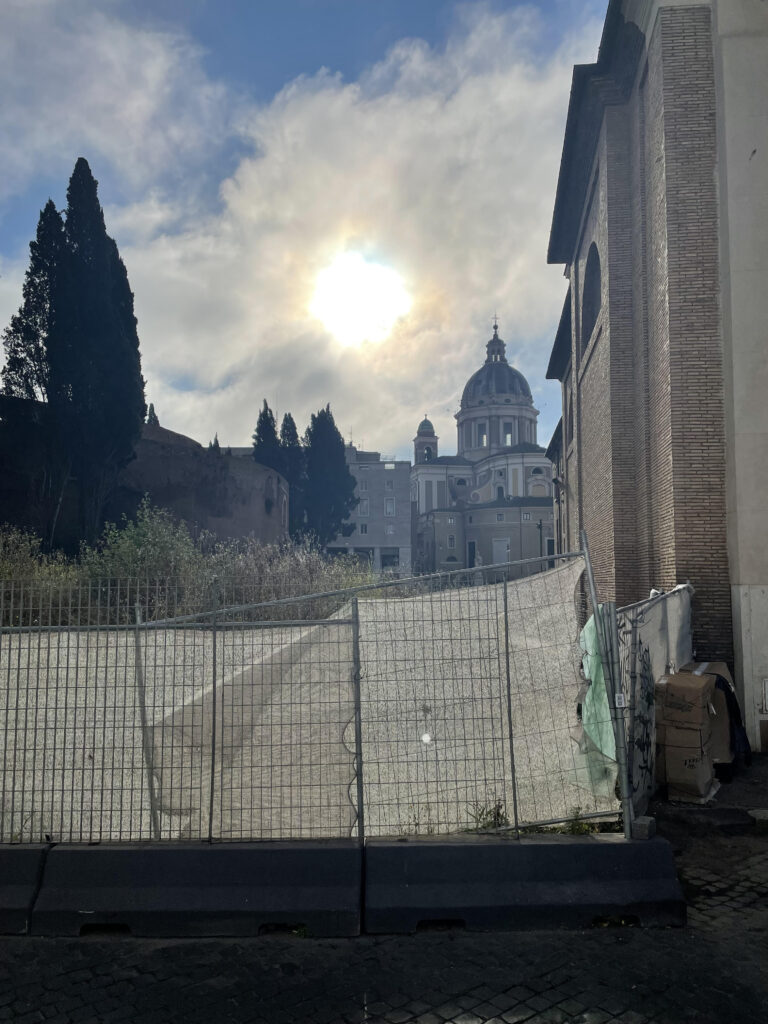
We made our way there very early Saturday morning, mindful of the funeral starting at ten. While I remember standing on the street looking at his mausoleum with not much around, now there is a museum next door – white and shiny, housing the Ara Pacis, the Altar of Augustan Peace commissioned by the Roman senate to celebrate Augustus’s return from three years away in Hispania and Gaul. With my back to the museum, staring at the mausoleum behind a shabby fence, I saw a homeless man rolling up his sleeping bag, and thought about the parallels between Augustus and the man who was being buried later that same day, a man who wanted his coffin to rest on the ground, wanted to be buried not in the Vatican but in a nearby church that was special to him. Who wanted a simple grave, with just his name.

I felt something as I looked at what was before me: a burial place for a great leader long gone, a falling down fence, a dome of a church in the distance. And something else: an opening in the sky, a portal – both an entrance and an exit perhaps. I began wondering again about what happens when we die, if there is a Heaven, if we come back again and again until we get it right. Mostly I wondered if Augustus and Pope Francis were connected thought the light in front of me.

I took a photo with my phone and marvelled at how it looked, showing it to my friend.

‘It’s like the sky is opening up to receive him. Or sending down light to replace his.’

My friend said, ‘Good shot. Your phone has a great camera.’

Know your audience, know your travel partners. That’s a good rule for life. We moved on, heading to St Peter’s for the funeral, as I thought about all the people who walked the same streets I now trod. All the people around me. Usually crowds make me feel lonely. That didn’t happen in Rome. But then, I was distracted by the officials keeping us safe.

*

Sunday evening rolled around and we found ourselves back at Termini. I told my friend I wanted to find the other end of the station, so I could look for the place I stayed at so many years ago. We wound our way along, looking for a place to have a drink before catching the train, mindful of the crowd, scanning for pickpockets… and then it appeared. The hotel I stayed at. Where I had to pay forty Canadian dollars for a call I made to someone in Canada I wouldn’t cross the street for now. Where I looked out the window processing hundreds of emotions.

‘That’s it,’ I said, pointing.

‘Do you want to have a drink there? Some sort of full circle moment?’ he said.

I thought for a second then shook my head. ‘No. She’s not there anymore.’

‘Who?’ he asked, looking around.

Once again I was leaving Rome, my mind swimming with all I had experienced, all I had witnessed, all of the thoughts I had on death and Catholicism and travel and where I want to live and… everything.

Augustus was a good leader who made Rome a better place. Pope Francis was a good man who made the world a better place. Maybe they are connected in some larger, cosmic sense. But I’m starting to believe you can reincarnate while being in the same body. I felt that in Rome, staring at a place I stayed thirty years ago that still stands in a city that has changed and grown and expanded. Much like me.

As we settled into the airport lounge to wait for our flight, I said I felt like finding a quiet corner to have a cry. My alpha male friend looked like he wanted to hop out the window and take his chances on the wing of the aircraft departing. I’m not everyone’s dream travel companion, either.

*

I’ve been back for weeks now. My small suitcase has been emptied and my large suitcase is being prepared for my next trip, spending the month of June in Canada, a trip I also booked in January. My mind is still whirring, and I keep thinking about Rome, wishing I had stayed for the conclave, or spent a day queuing to see where Pope Francis now rests instead of watching from outside.

 I couldn’t get close enough to the Trevi fountain to throw in three coins, like I did last time. But I know I will return – the appeal of Rome is eternal.

We All Need to Yell, Sometimes.


I was home for Easter one year during university – I’m not sure which year it was but I’m banking on my third, when my living accommodations were a nightmare. As I looked out on the dismal pre-Spring brown of dead earth and mud I said to my dad, ‘I really don’t like Easter. Nothing good ever happens to me this time of year.’ Dad looked up from the grapefruit he was peeling and said, ‘I doubt our Lord was too fond of it, either.’
I laughed. My dad could always make me do that, no matter how dark the times.
Growing up it seemed the weather was always filthy over the Easter break. My first and later second big break ups played out over the Easter weekend. I came to loathe that time of year.
In 2011, Will and Kate decided to get married the week after Easter, which meant two four day weekends in a row for us living in England. I contacted Andrew, my travel partner, and said, ‘We’ve done northern France, now how about the South?’
He was in. After some plotting and planning we decided we’d fly into Carcassonne, rent a car, and head out on a Knight’s Templar tour.
‘I should warn you, though. Nothing good ever happens to me over Easter,’ I said. ‘Best be prepared.’
‘I will keep it in mind,’ he said.

I landed in Carcassonne a day before Andrew, armed with a new map and a plan. While most people would consider me well-travelled, Andrew makes me look like a homebody. So I decided to do some exploring before he landed, so I could show off a bit. After dumping my bags at my less than spectacular hotel located on the Canal du Midi, I made my way to the fortified city on the hill. It was a thirty-minute walk, give or take, but I can’t be sure, as I was distracted by the shoe shops. The modern city of Carcassonne is home to so many nice shoes stores that I started taking pictures of the window displays and sending them to my sister, who owns so many shoes her husband has dreams of them falling out of the kitchen cupboard and landing on him. The sun was shining and it was the start of a two week holiday in France. Frankly, it doesn’t get much better in my world.
Eventually I made it to the medieval city, perched majestically on a hill, only having to ask for directions twice – once when I was standing under a sign with a big arrow pointing to my destination. The lovely tall Dutch lad barely laughed as he turned me around by my shoulders and pointed. ‘Right!’ I said, and I was off. I clocked the different entrances and exits, aided by the fact that you needed to cross a drawbridge, so it wasn’t like I was looking for a small exit sign. Step one was done – I knew how to get to the old city.
Legend has it Carcassonne got its name from the dame of the castle, who, when it was under attack and she learned there was only one pig and one bag of wheat left, fed the pig and flung it to the attackers, who upon seeing the hefty flying side of bacon, assumed the people inside had enough supplies to keep them going for a spell and left. After the attack was thwarted the city bells rang for her, or the ‘carcas sona’. No one knows if the story is true or not but as I stood there I found myself hoping the pig was dead before it was launched over the incredibly high walls.
As I wandered, I studied my path with all the attention of Hansel and Gretel being led into the forest, clocking interesting things to point out to my friend and making note of shops I could use as reference points. After walking around for a few hours, I figured I’d learned enough that I could impress my friend. So I headed back to the land of shoe shops, thinking a treat was in order. I was feeling pretty good about myself.
The roads slope down from the medieval city, the houses interspersed with shops. As I looked, and walked, I saw a gentleman in a suit standing on the sidewalk. As I got closer he smiled at me, and I saw that his pinstripe suit was well made but old, not in tune with current trends. I could picture him, a much younger man, being measured by a tailor, perhaps for his wedding. That made me like him for some reason. As I approached, I saw that he was standing in front of a World War II Museum. He asked me if I would like to look around, and I nodded, smiling. How could I say no to a man who put on a suit to work at a museum? I stepped inside thinking I would give it twenty minutes and then hit the shoe shops. He was pleased as he ushered me through the door, and I got the feeling that whatever was inside was very important to this lovely man.
The museum was small, like it had been converted from a family home. I was greeted with that smell that seems unique to museums, like old manuscripts and dust, a scent that makes me feel nostalgic. I paid a small fee to enter, a few euros at best. The man told me a bit about the museum, but I was working so hard to understand his French, I missed the context of most of it. He gave me a brief tour of the layout and told me to find him if I had any questions. I could see the sunshine out the main door, and a part of me wondered how long I had to stay to make a good show. I wasn’t in museum mode, I was in walking in the sunshine and buying shoes mode. Plus, I wanted to find a good restaurant for my friend’s first night in town, and a bakery to buy breakfast. I had plans!
But the more I walked, the further the museum seemed to go. It was not wide but deep, and must have been two family homes originally, possibly three. I bypassed the clothing part, as military uniforms make me itchy looking at them. I read about Jean Moulin, the hero of the Resistance. And then I discovered some older photos, black and white, and gravitated towards them.
I love looking at pictures of young soldiers from World War II. I am not sure why, but it is unique to this period. When I see pictures of soldiers from World War I want to hold them in my arms. I send up prayers they weren’t gassed. World War I makes me weep in a way few things do, so I tend to be gentle with myself where photos are concerned. Soldiers from World War II all seem to me to be so handsome. They have a twinkle about them. I know the darkness, the evil, but I concentrate on the gallantry of the time.
I started flipping through the photos, placed like we used to stack albums at record stores. But they weren’t soldiers. I wasn’t quite sure of the theme at first, but then it dawned on me. Jews being rounded up. And suddenly the sunshine outside dimmed, and I got that weird, tight feeling in my throat that happens when you think of the Holocaust. My hands shook a little, and I looked to see the man in the suit watching me. I could have stopped, but that seemed wrong. Each person in the photo had a story, and in some small way I felt I was honouring them, perhaps remembering them, simply by looking. Isn’t that a responsibility we all have when it comes to history?
The photos were 8 by 10 with the white border you used to see, pressed against cardboard and covered with protective plastic. Women lined up at a concentrations camp. Naked. One of them holding a baby in her arms. I didn’t need to read the caption to know they were told they were going to the showers. But it was the gas chambers. We’ve seen those photos in history books. We know what happened.
I could not stop staring at the woman holding the baby. I thought about how afraid that mother must have been. I thought about what faced them. I thought about her pregnancy and if she had been excited or scared, knowing what was happening in her world. But there was more to it, something else. The way her hair was cut at the back, the way she was holding the baby. The slope of her shoulders. She looked exactly like my sister, in a picture I have of her holding her daughter, wearing blue shorts and a taupe shirt in the backyard of my parent’s home many years ago. We had a summer barbecue that day and it was a contest to see who could love my new niece the most.
My heart started to race, and the room tipped slightly. I remember pressing my left hand against the shelf to steady me. A little voice said, ‘It’s ok, put the picture down, step outside, it’s over.’ But I couldn’t. A few hours earlier I had been sending that same sister pictures of shoe shops. Now I was looking at her double, a few moments from death at the hands of the Nazis. Holding a baby. My eyes filled with tears and I knew I was in for one of those crying jags that you feel inside, days after your tears dry. Standing there, looking at the photo, I made space for a new kind of pain in my heart.
I don’t know how long I stood and stared. When I lifted my head the man in the suit was walking towards me, a concerned look on his face. I knew I was pale, for I had felt the colour drain from my body, as my heart felt like it was working overtime to keep me standing up. It felt like someone had picked me up and shaken me, and even as it was happening, I was staggered by how my body was responding to this photo.
I set the picture down gently, as though my physical actions might cause the woman to drop the baby. I thanked the man in the pinstripe suit that had held up well but had seen better days, and for a few seconds I saw a fedora on his head. It was so clear, I blinked a couple of times, and it disappeared. But I knew I had seen it. I still know it, now, all these years later.
I made my way outside. The sun was high in the sky, the day in full bloom. I put my sunglasses on because tears were still falling and dipped my head, which I think is universal code for I’m falling apart but pretend you don’t see me. I walked awkwardly back to the main part of the city, adrenalin making me so twitchy that when I checked my phone to see my sister’s messages, like that was proof she was alive and unharmed in Nova Scotia, it slipped from my hand and clattered across the street.
I have never felt so wobbly in my life, and that included when I worked in radio and suffered from vertigo. Instead of buying shoes, I sat at a café and drank a big glass of wine, then went back to my hotel, curled up like a hedgehog, and tried to get warm again.

The next day I met Andrew at the tiny airport. I had wanted to greet him as he got off the plane, but I was late getting there after a lousy night’s sleep. My plans to impress him were shaky at best, as I concentrated on plastering on a smile and being happy, dammit, all while thinking I might be sick at any moment. I took comfort in the fact that if I looked rough, he would think it was due to a few glasses of wine the night before. Being sad on vacation is just not done, although in 2009 we both cried our way across the Somme.
‘I walked to the medieval city yesterday, so I know the way. It’s really pretty, and I’m so glad the sun is shining today,’ I had a slightly manic note in my voice, and I knew he could hear it by the way he studied me. We picked up our rental car and headed out. As the car made its way up the hill to the old city we passed the museum. I turned away from it, beaming my attention on my friend. I didn’t want to see the man in the suit. I didn’t want to think about the picture. But that was the only thing I was thinking about.
And so we climbed, up the path, to the drawbridge, and entered.
‘I wonder what the knights would think if they came back and discovered they fought and died so that this place could sell t-shirts?’
‘But think of the good stuff they would experience!’ I said.
‘Like hot showers and better career options than being a knight?’
‘Exactly.’
That is why Andrew and I travel well together. We have a similar outlook on life and a love of travel which helps, but our sense of humour is in sync. And it felt good to laugh with a friend. It kept some of the darkness at bay. But with each step I took, I carried her with me, that woman who was photographed on her last day of life, that baby who never got to live. I pointed out a well, and the few things I remembered, but mostly we walked silently, the sunshine on our shoulders. Every time I feel that it makes me happy to be alive. But it also made me feel guilty, too. I’ve had it pretty easy, overall.
In the bright sunlight of the day we sat in a back garden in the medieval city and drank beer and ate croque monsieurs and planned our trip. As we left, I asked if we could walk a different path to the main city. Andrew lifted his head, looked around for a few seconds then pointed, and we headed left. After a few blocks I knew where we were. All the plans I made to impress him crumbled around me.
We walked around the quiet city, the shops closed since it was Good Friday. We ended up buying groceries and eating on a picnic bench outside the gite where we were staying. The woman who owned the place was recently divorced and had an air of hurt and loneliness about her that made me want to hold her hand. Andrew opened a bottle of wine we’d bought, and we drank it together, while I thought about the pain of loneliness. As I sat there on the second day of my vacation, I remembered telling my dad nothing good ever happened to me over Easter. If he were still alive then I would have called him, told him about the photo, said the Easter curse had struck again. But he was gone, and I was on my own.


Six months after the trip to France I found myself with my sister, walking along a Florida beach as the Atlantic Ocean shimmered besides us. I thought about telling her about that photo in Carcassonne but was hesitant. Would she want to know I saw her doppelganger in a photo at a death camp? I didn’t think so. And somehow it didn’t seem right to bring the darkness into the few moments of perfect light we were experiencing.
I have thought a lot about those two weeks in April long ago that changed me somehow. Thought about it until the starkness of it faded and it became its own part of memory. I think about it again now as we commemorate World Holocaust Day, seeing dignitaries lay wreaths at Auschwitz, hearing the incredible stories and unparalleled dignity of the few survivors who remain. I have thought about it as I believe more and more in reincarnation, and I wonder what fated me to see that photo.
Nothing good happens to me over Easter. But nothing truly terrible has ever happened either. I learned that in France, from a charming man in a blue suit, who I pictured in a fedora, and who I still wish I had hugged.

All Those Days Ago

Writing a book involves a lot of time thinking ‘What if?’ and then playing out scenarios, wondering if they are realistic, if they drive a story forward, if they work – and if I want to write them and if anyone will want to read them. I seem to do this with my own life more and more, now that I am older. What if I had studied something else, moved someplace else, had stayed home the night I met someone at a bar who would change the course of my life – and not for the better. Events and missed opportunities from the past play out in my mind often as I go about my day, buying groceries, walking in the park, working out at the gym. Lately one plays out more and more in my head.

My second year of university I took a bus trip from Ontario to Fort Lauderdale, Florida. It was me and a girl from my residence and two of her friends and forty strangers on a long bus ride that saw mechanical issues in Montreal and extreme delays. By the time we got there we were a day late and the bus had a ripe smell of unwashed bodies and a dodgy toilet. We passed the time braiding each other’s hair and listening to music. Guns N’ Roses were big at the time.

I can’t remember the name of the hotel, but I do remember a lot of things about our eventual arrival and that trip. As we got out of the bus in the parking lot and the driver started pulling luggage from the hold, my friend bent down to get her bag as a coconut fell from a tree and hit her in the head. I almost fell down laughing. She was not impressed with me. I have always had a strong appreciation for physical humour, and it has got me into trouble a few times.

We checked in, took showers, pulled on swimsuits and headed to the beach. I used SPF 2 and burned like a marshmallow over on an open flame and spent the rest of the trip spraying myself with Lidocaine. At the local bar, I think called the Candy Shop, I had to wear a big wrist band saying I was underage. I ordered a diet coke (which I never drink) and was served a rye and coke (which I had never drunk before or since) and thought I was going to end up in prison. Some sailors from Australia where there and one took a shine to me. As I tried to avoid him he kept telling me not to be so shy. A guy from Ryerson in Toronto rescued me, and I had a little holiday romance. He bought me roses from a street vendor and we walked along the beach. His name was John and I still think about him.

At a pool party I ran into someone I went to high school with. It was a peculiar interaction, as he sent his friends over to ask me if I was who he thought I was. We chatted for ten minutes. It was more than enough time.

The shop across from the hotel sold little chocolate cheesecakes and I packed away a few of them on the trip. I went through a stage where I thought cheesecake was the work of magic fairies, but I don’t care for it much anymore.

We were all sharing a new clear shampoo by Dep I think. It smelled divine and I looked for it for years after, wanting to experience the scent again, but can’t find it.

It was a good trip, and all these years later I still remember it fondly.  

On the way back, I was standing in MacDonald’s in a different state, I’m just not sure which one. A few of the buses ferrying Canadian students back to the land of snow and ice were filling the parking lot. I remember I was wearing white jean shorts, a peach coloured anorak I bought from a beach shop, and white tennis shoes. My skin was a mixture of soft tan and fading burn and my was hair pinned up. I was standing with a group of girls from the trip, drinking fountain pop and not eating as I’d run out of American money when a guy nearby broke off from his group and came over to ours. He started talking to me. In my memory he looked like a young Wayne Gretzky – no small thing back then. He told me he liked what I was wearing, that I knew how to dress. Everyone had bought what I call a festival anorak, with Fort Lauderdale and the year (which I am keeping to myself) written along the side. I have never cared for clothing with writing, so I bought a plain one in a peach and cream herring bone pattern.

I remember wondering why he was talking to me when I was standing next to my tall, gorgeous friend. I flashed back to the sailor telling me not to be shy – I had no interest in him and was trying to let him know, but this guy, well he had something. And I couldn’t figure out why he was talking to me. He tried a few times. I was tongue tied. And he walked away.

My friend said, ‘he liked you. He was trying to talk to you.’ 

I did not pick up on it. With him I was shy. It’s happened to me many times in life. Someone really interesting comes along and in my mind I wonder why they are choosing to pay attention to me. I spend so much time lost in my thoughts the person gives up, then I want to chase after them and say… hang on. I’m actually normal.

Most of the time.

Here it is, thirty years later, and I still think about that guy at MacDonald’s. Because I have a PhD in Dwelling, and I am addicted to making myself unhappy. But also, because I like to play the ‘what if’ game.

What if I had picked up on it? Because he was cute, and outgoing, and I was standing in my happy place in the US, not MacDonald’s but the eastern seaboard. Say I had picked up on the signals, like any normal female probably would have. And say we’d had a great conversation. Say we kept in touch, and he wrote me long letters, because he strikes me as the kind of guy who would, and we fell in love. That would have saved me from a few dark relationships in my twenties that changed me as a person, and not in a good way. Maybe he would have been the one. And maybe… well, there are so many maybes. So many what if’s.

If he ever thinks of me I hope he knows I was shy, the way I am around men I find attractive. I hope he doesn’t think I was rude. And I hope he knows like with many moments in my life I wish I had that one to do over. And I hope the next time he told a girl she looked nice, she smiled at him, as I wish I had done.

It’s long gone. The memory remains. Maybe there’s something in that.

*

Many years ago I was driving with my mother on a backroad in Nova Scotia, on our way to visit my father who was in the hospital. Two squirrels ran out on the road and I saw them, but I was also aware of a transport truck behind me. I couldn’t brake or swerve. And I hit one. It was my first and only roadkill and I felt sick as it happened, and sick now thinking about it. I said to my mother, ‘Oh God. I killed one. Do you suppose they were a couple?’ To this day I have no idea why I thought this but my mother said, ‘You never know. You might have done them both a big favour.’ I still think about that, too.

Sometimes I believe everything happens for a reason. Sometimes I believe there is an elegance to the world, a plan if you will. Other times I think we are given opportunities and have to make the most of them. Sometimes I think I missed the opportunity for a wonderful romance with a boy who looked like Wayne Gretzky on a bus trip to Florida. But then I remember what my mother said when I hit a squirrel on a backroad in Nova Scotia. Maybe I was spared pain. For now it remains a ‘what if’ in my life, unless I use it for inspiration instead of despair, and turn it into a story, into a book. Make a few bucks to take another trip. And this time if someone speaks to me, I plan to be ready.

My Friend’s Son

My friend’s son is into mountain biking. I don’t know much about the sport. I know I like the looks of mountain bikes more than that of a ten speed, the lines being cleaner and the bikes themselves looking stronger, but that is the beginning and end of my input on the subject. He’s preparing for a race and as I asked him question after question his mom suggested he show me a race on the computer. 

It was eye opening to say the least. 

As a bike flew down dusty, curvy trails, whizzed into tunnels and sped dangerously close to trees I said, ‘Are you ever scared?’

‘Sometimes,’ he said, with breathtaking honesty.

 And then, a beat later he added, ‘It’s all about trusting yourself and your bike.’ 

I felt that funny feeling I get when I know I have heard something I am going to dwell on, turn over endlessly in my mind and maybe adopt as a new belief.  

It’s about trusting yourself and your bike. I’ve never met a bike I’ve had any sort of relationship with but the idea of a bike as a metaphor for life danced in my head and made me think about the idea of trust. The role it plays in life, in our relationships, but mostly the idea of trusting yourself.

*

I was on my first trip to BC in twenty years and I was dizzy by how much everything had changed. Landing at the airport and seeing the shops, the brightness of the place after Heathrow, the impossible beauty of the mountains as they stood in the distance, I returned in my memory to the person who had left a much smaller city, a person who was struggling after a bit of illness, a bad but necessary breakup, and a career change I still question. The friend I was on my way to visit had a front row seat for all of it. She had seen me when I was in her words ‘scary thin’, had picked me up from a visit to the hospital where she literally helped me get dressed and had shared her circle of extraordinary friends with me. We had danced at the Side Door, a bar long closed, cooked together in the kitchen of our shared home and become friends. The kind you always trust to have your best interests at heart.

I had big plans for my visit, some to do with family, some to do with promoting my books. Much to do with reconnecting with old friends. One day my friend and I went shoe shopping on West 4th and once I recovered from the shock of the prices I thoroughly enjoyed browsing, buying a new pair of Converse trainers. The last pair I ordered online felt flimsy and soon began to squeak. I thought I might have been duped. The pair I picked up had the weight I was used to.

Once back in the car my friend asked where I wanted to go next, and I asked if there was a bookstore nearby. We ended up at Indigo on Granville and 10th.

My old neighbourhood. Where I had lived for four years. I remembered when the shop was a diner and I remember when the bookstore opened. I smiled as I recalled spending rainy afternoons picking up book after book, reading the first sentence and making a little pile to buy. I still choose books the same way – nothing that starts with dialogue and nothing first person. A first line that makes me think, ‘wow, someone wrote that’. As I browsed the shelves and talked to the very kind staff about my books (first line in one: ‘Bullets sing.’ – I’m still proud of that – and in my second book: ‘May is an awkward month to start over.’) I felt the enormity of where I was. Thought about how much I had changed, of course on the outside, but the most profound changes were on the inside. I felt more were coming, and I braced myself.

‘When we finish here, I’d like to walk over and see the apartment where I used to live,’ I said. She got it. She understood.

So as the sun lit our way we walked over. Stood in the street. I pointed out the apartment where I didn’t so much live as survive, struggling with who I was when I lived there, and who I wanted to be. I worked to feel compassion for the young woman who was dealing with so much change, and growth, and I apologised to her for letting her down. For not dreaming bigger. For accepting things she did not deserve.

‘It’s smaller than I remember,’ I said.

As we walked away I thought about this, how the small building and the small flat loomed so large in my life. As I wished whoever lived there now, in the pretty little building so close to so many things a happier time than I had, I turned and walked away.

When we returned to my friend’s gorgeous home, a home that vibrated with the family love that echoed inside, she started dinner while I spoke to her son about mountain biking. It was then he shared his wisdom about trust.

I am surmising because I have no intention of ever finding out for myself that in a mountain bike race, you see the troubles coming at you, the solid and imposing trees, the dips and drops in the path, the sudden turns. You have time to react, recalibrate, prepare. As you climb on a bike you anticipate what is going to happen. Wheels roll, pedals turn. Gears shift. Life doesn’t work that way. Things come at you suddenly on a random Tuesday that blindside you. And things happen gradually, as if in slow motion, and no matter how hard you might pump the brake, the movement continues. You can stop a bike. You can change direction. This is not the case with life. All you can do is hold on and learn to deal with the bumps. The very best you can do is to trust yourself in the race of life.

Later, meeting her son in Whistler I watched as he somehow defied gravity and jumped a flight of steps with his bike and without so much as a flick of the wrists. I wanted to ask him how he did it but I also didn’t want to come across as his mom’s weird friend. I figured I was already dancing with that as it was, with my awe at the beauty of BC, my concern over all the bears people told me I was going to see, and my sudden fascination with a sport I’d never much thought about before.

Still, it kept crossing my mind, what he said, as I sat on ferries and buses and dealt with the landscape of my past in all its beauty and its sorrow.

What if I had trusted myself more, earlier in life? What if I’d trusted myself to study creative writing instead of broadcast journalism? Trusted myself to walk away from bad relationships believing there was something better waiting for me?

What if I had trusted myself more with my own life?

My friend’s son is sixteen years old. You can tell from his quiet calm demeanour, his lovely manners, the way he thinks, that he’s going places in this world. I just hope he does it with all of his limbs intact. 

Land, Part Two

(Apologies for some repetition…)

D-Day

There is something about Bayeux, France that brings me great comfort and peace. In unsettles me, too, but in a good way, a way that reminds me that life is filled with wonderful mysteries.  

Bayeux is a medieval town in the commune of Normandy, in northern France, about seven kilometres from the channel coast. It is famous for the Bayeux tapestry, a very long piece of embroidery depicting the conquest of England by William the Conqueror, who also happened to witness the consecration of its cathedral, Our Lady of Bayeux, built in the 11th century in the Norman-Romanesque style and rebuilt in the 12th century in the Gothic style. But that’s stuff you can get from any guidebook. It was the feeling of the place that drew me in. A feeling I’d never had before, despite all my travels and all my visits to new and wonderful places.

I arrived at the train station on a cool June day with a friend. We’d been visiting the battlefields and cemeteries of World War I, where his grandfather had fought and where my great uncle through marriage was buried. After a few days to recalibrate in Paris, which we sorely needed after visiting la Musée de la Somme in Albert and Beaumont Hamel in Auchonvilliers, we decided to see the landing beaches of D-Day.

I had no idea how much this unplanned part of the trip was going to change my life.

My friend and I have travelled all over the world together and know each other’s strengths and weaknesses. He has a great sense of direction (strength) and I am an excellent follower (also a strength). But something happened to me in Bayeux. Something magical. I knew where I was going. As I headed through the streets, away from the station and toward the town, I felt a tingling sensation, and knew something profound was happening, I just didn’t know what. As I stared at the homes that lined the road, my friend trailing me for the first time ever, I turned and said, ‘I know this sounds crazy, but I feel like I’ve been here before.’

‘You said you’ve never been to northern France,’ came his practical reply.

‘I haven’t, in this body,’ I said.

We walked in silence, him accepting this new bit of information I offered, me walking calmly but feeling like a whirling dervish inside. I wasn’t sure what was happening, but I was loving how alive and connected I felt to this brand new bit of the world. How familiar it seemed. A fluttering sense of belonging pulled me forward, to a place I knew I was meant to be. It was both exhilarating and unnerving – what, exactly was happening? As I passed the cathedral I almost expected someone to wave to me, a friend from another life reconnecting.

I have travelled many places and have a list of favourites I add to regularly. Paris brings me joy and makes me wish I had both French girl flair and a flat in Montmartre. Florida makes me appreciate jeans shorts and cold beer. From the moment I stepped inside the Bangkok Airport I knew I was going to love Thailand. And I did, and I do. The heat, the people. But Bayeux is the only place I’ve ever been where I thought, this is it. I’ve found my place, I can stay.

And it was about to get better.

I’ve known since the day I read Paddington Bear as a first grade student in a small school in eastern Canada that I wanted to be a writer. And I was, in many ways. I wrote great book reports and excellent essays. At least that’s what my English teachers told me. My math and science teachers threw up their hands and probably took early retirement because of me, but my English teachers were always in my corner. I wanted to be a writer but didn’t quite know how to voice that desire until later in life, after I burned through a few questionable career choices and navigated the world of depression. Through it all I scribbled and scribbled and outlined. I had a draft of a first novel sitting in a drawer, a novel that ‘started off very well’ as one agent told me. I’d set it in Maine, a state on the eastern seaboard of the United States and one of my very favourite places.

But it was in Normandy where the idea for what would become my first published novel came to me, almost completely, as I visited Omaha and Juno, saw Ardenne Abbey and learned about the massacre of Canadian soldiers just after D-Day. As I walked and learned I thought about what it must have been like for these soldiers, knowing they were about to be executed, shaking hands with their friends before being led away to die. The powerlessness over their own lives, the unnecessary brutality of it. I thought about the people who had their land, their homes, their way of life invaded by an enemy. And I thought about all the lives impacted for generations to come by the war.

As I roamed the cobblestone streets and ate at the fabulous restaurants, I felt the memories of the place, the darkness and the light. It felt like someone was whispering in my ear, telling me bits and pieces of their story, wanting me to weave something together from all the paths that crossed in the small part of northern France. I made more and more notes – some even on restaurant receipts if that is where the muse hit – and I daydreamed.

I was working full time and started getting up early to write before going to work. This more than anything made me feel like a writer. It took a few years and many edits before The Time Between Us found its way into the world, but it all started with a sense of connection I had with Bayeux, France.

Travelling for me has always been about the feelings that well up when you visit someplace new and open yourself up to the magic it holds. You can pick the places you want to visit, but sometimes the place picks you, to share its secrets, to tell its stories, provide the backdrop to make your dreams come true. That’s what happened to me in Normandy, and I am so glad it did.

My book came out November 11, 2021. At the time I said I would be grateful for 50 nice reviews on Amazon. I now have 1,355 – most of them more than nice. A complete stranger contacted me to tell me my opening scene was a ‘belter’. Once I learned what that meant (very good!) I was delighted. The Time Between Us opens on D-Day, and it is the scene that got the attention of my agent. Remembering the day I spent at Omaha, toes in the cold water, thinking about what those men who fought went through, something happened to me. A new voice filled my head. My creativity came alive.

Looking back now, I think it might have been an extreme example of psychogeography, the way a new place affects the emotions of the person visiting. But you never know. Maybe my characters had lived there and chose me to tell their story. Maybe they met me at the train station and moved me towards the city centre. Maybe I had been there before, in another life. Or maybe I was just ready for the right story to find me, in the right place, at the right time.

Whatever it was, Bayeux is where the magic began, and I will always be grateful for the feelings of connection I experienced walking its beautiful streets and dreaming.

Light and Land

My father grew up in a small part of Nova Scotia near New Glasgow. It was about a three hour drive from my hometown, and we made the trip often before my grandmother died.

One trip we made was on New Year’s Eve, when I was about eight years old. It was getting dark when we hit a patch of the Trans Canada that was dotted with old homes – five, maybe six of them, spaced well apart. Perhaps the owners didn’t want to sell when the highway went in, or maybe it was a part of the road used so seldom back then it didn’t matter. In my memory the houses are all hunkering two story affairs with big front porches and farm equipment lurking nearby.

They were, for the most part, all glowing with Christmas lights. This was back in the day when lights were long strings of multicolour bulbs, some of which burnt out in the time between being put up and taken down. Orange was a prevalent colour I seem to remember, and an amber kind of yellow, like at a traffic light. The blue were my favourite and I used to scan the long rows that ran along the eaves, the squares of lights framing the windows, for the soft halo of illumination they gave. It was before the days of clear lights, wire reindeers and restrained decorations. These lights seem to scream, like they wanted to send a signal saying, ‘We are still here, look at us! It’s dark out and this is an isolated stretch of road, but it is still magical!’ At least, that was how it played in my eight year old head. Maybe I was seven? I don’t know, but I do remember we were all sitting in the front without seat belts, me between my dad who was driving and my mom who was always the front seat passenger. It was a very different time.

As the sun set and the sky darkened, my mother observed to my father that it looked like a lot of time and energy was spent on the lights. Until a house appeared, dark and almost cowering in the dimming night sky. It had no Christmas decorations – the only light at all was a haze that came through the front widow, spilling over from the light in the kitchen at the back perhaps. It was impossible to make out the colour of the home, and the very building seemed to be collapsing into the darkness.

‘Look at that one,’ my mother pointed. ‘Strange to see it isn’t decorated when all the ones around it are so bright.’

‘Probably couldn’t afford to,’ my father responded.

And just like that, I was worried. About the family, about any kids that might live there and if they had or hadn’t got any Christmas presents. About them being bullied at school for not having decorations. And strangely, about the house itself. Were the floors sagging, needing to be reinforced? Were the walls damp from the cold? Was the house ashamed, embarrassed, by its darkness? Did it remember better days, different families dwelling within, and yearn for those times?

I don’t remember New Years eve or what we did. I don’t remember looking for the house in the daytime, on the journey home. But I still remember seeing the house, devoid of holiday decorations, how it looked next to the others. The sadness I felt, that has stuck with me. Visited again, in different countries, different places. Because sometimes, a house, a strip of land, a place will speak to me. I feel its energy. Since that day when I was eight (or maybe seven?) and felt badly for that house, I’ve had other connections which may seem odd, but have become one of my very favourite parts of travelling. There are places I have visited where I have no emotional response, places I enjoyed but to which I felt no connection. And then there are some what all but absorb me, like they have been waiting for me to visit. Those are the places to which I return.

*

On a trip to France many years ago, I left a train station and started walking, ahead of the friend I was with. I had a sense of familiarity about the place, a feeling of returning and being met with open arms. I told my friend it felt like I had been there before and he said, ‘I thought this was your first time in Normandy?’

‘It is in this body,’ I replied. He was silent as we walked the rest of the way to the hotel, me cutting a path across cobblestone streets that felt familiar under my feet. He didn’t shake his head or laugh; he just accepted this part of me. It is why he is a friend, and why we travel so well together. We have spent many days in France, taking epic road trips and visiting battle sites. While all are poignant, some are almost overwhelming to visit. There are many parts of France where you can still see the trenches cut into the ground from the battles of World War One. Can see the ridges and valleys created by the mortars and bombs that rained down over one hundred years ago. The grass that now covers the gashes is almost like scar tissue, a layer of protection and a constant reminder of what once was. The torn holes made in the earth have been covered over but have not healed.

On the opening day of the Battle of the Somme, the artillery could be heard in England, across both land and the water of the English Channel. I find that staggering to think about. How loud would it have been for the young soldiers who were fighting in the thick of it? The land I think still feels the pain, still holds the memory of the young boys who fought and died there. You can feel the sadness, and I think the land still mourns. I think it always will.

As you walk to the Vimy Ridge memorial outside of Albert, France you are restricted to a paved path that winds its way from the visitor’s centre to the extraordinary and overwhelming memorial where Mother Canada weeps for her dead sons. On the grassy slopes that run along the pavement are signs warning of undetonated explosives. You must stay on the path they say. Walking along, I wondered what would happen if someone tripped and fell, accidently sprawling on the ground. I wondered about the work that went into laying this path for tourists to come.

A guide told us there are factories working 24 hours, seven days a week to deactivate recovered shells, and it will still be many decades before the work is done, if it ever is. The shells must have fallen like rain drops. How did anyone survive?

At Beaumont Hamel, a sign says the ground you are about to walk on is sacred. As I walked it one cold morning in June, I saw where entire regiments of Newfoundland soldiers were buried where they fell. I saw the Danger Tree which marked the gap in the barbed wire where soldiers filed through, and learned they were picked off one by one by the enemy, hunkered down not very far away. I think the land remembers this. I think it knows what happened. I think it weeps for the inhumanity people show one another. I also think there is a lightness to land that has not witnessed an atrocity. And I think people feel the effects of this, too.

Cities have energies. Some are lethargic, some are young and keen. I feel it when I visit. And I am not alone in this. People who have the travel bug the way I do feel it, too.

Once, many years ago, I visited Greyfriars’s Cemetery in Edinburgh, Scotland. In the corner of the cemetery is the Covenanter’s Prison. For four months men who supported the National Covenant at Bothwell Brig were imprisoned in this area. They had no shelter and were given four ounces of bread per day. Many died. Some were executed. As I stood with a friend I said, ‘this sounds crazy, but I feel like I’m standing near a fire, like I’m burning.’ As we left we stopped into a shop and learned of paranormal activity in the site of where we had just stood. People had reported a sense of being warm, like they were burning. My friend went pale. I shrugged. These things happen to me, and I think it all started when I felt sadness from an old house that stood out from the others. But I’m older now. I know that there are worse things than being poor. That house could have been filled with love and kindness and the ones that shone so brightly could have hidden deep, dark secrets. I hope not. I hope they all looked out for one another. And I hope in the holiday seasons since that time, they all glowed with joy.